How do scent detection boxes work? Everything about training scent dogs with boxes
Share this article
Your dog has a nose that is hundreds of times more sensitive than yours. But how do you teach him to use that nose with purpose? How do you turn an enthusiastic family dog into a focused searcher who finds odours on cue? The answer starts with a simple but well-thought-out tool: the scent detection box. In this article we explain step by step how scent detection boxes work, how to train with them effectively and why the DaanZ Detection boxes are designed to make the learning process as smooth as possible.
What is a scent detection box?
A scent detection box is a container in which you can hide an odour. Your dog learns to find the right one among several boxes: the box that holds the target odour. The concept is simple, but the execution makes the difference between a dog who learns quickly and a dog who gets frustrated.
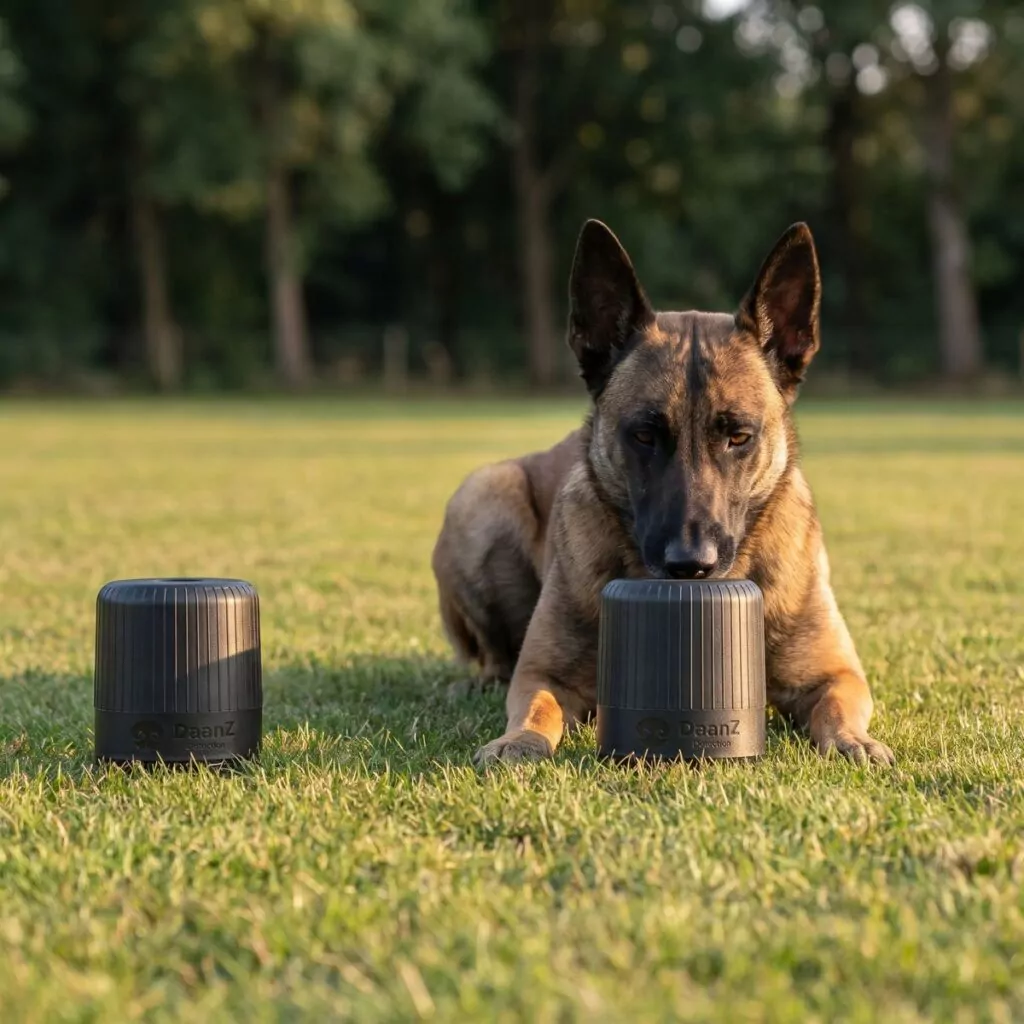
The DaanZ Detection boxes are designed specifically for training dogs. Their round shape makes it easy for a dog to take a treat out. They also have a screw cap: you can leave the box open for beginners' training and close it later for more advanced exercises. That makes them suitable for every stage of the learning process.
A well-designed detection box is more than a tub with a lid. It is a training tool that helps your dog understand, step by step, what you expect from him. And that always starts with the basics: the link between odour, behaviour and reward.
Why train with scent detection boxes?
Detection boxes give the training structure. Without boxes, scent work is an abstract and confusing idea for a dog. With boxes you create a clear, repeatable exercise: the dog searches, finds the right box and is rewarded. That predictability is crucial for learning.
The big advantage of boxes is that you can control the difficulty very precisely. You start as simply as possible and build up slowly. Your dog doesn't need to understand scent work straight away. He only needs to learn that sniffing at a certain box earns a great reward. From there you take it one step further each time.
Boxes also keep the odour in one place. In a free search, odour can spread, drift with the wind or cling to other objects. In a box the odour stays controlled and concentrated. That makes it much easier for a beginner dog to find the source and to understand where the reward comes from.
Working with detection boxes is also an excellent way to build your dog's focus and confidence. Every successful find confirms to your dog that he is doing well. That success adds up, and after a few sessions you'll see a dog who searches with more purpose, more calm and more certainty.
The design of the DaanZ detection boxes
Not every detection box is the same. The DaanZ Detection boxes were designed on the basis of years of experience training detection dogs. Their key feature is the adjustable lid system with a screw cap. It lets you use the box open, with the lid, or with the lid and an insert. Each setting matches a different stage of training.
The DaanZ boxes are weighted with a metal disc built into the base. Combined with the HDPE construction, this keeps them firmly in place during training.
The round shape of the box is a deliberate choice. A dog who is new to scent work needs to be able to take the treat out of the box easily. Sharp corners or deep containers make that harder and can cause frustration. Thanks to the round shape your dog can reach the food smoothly with his muzzle, without a struggle. That keeps the experience positive and the motivation high.
The DaanZ detection boxes also come with interchangeable inserts. These inserts raise the difficulty of the exercise. They narrow the opening of the box or change the way the odour comes out. It is a unique system you won't find anywhere else, and it makes the boxes useful from the very first introduction all the way to competition level.
Phase 1: an open box with visible food
The very first step in detection training is so simple it almost feels too easy. That is exactly the point. You put a few detection boxes on the floor and place a piece of food in one of them. The cap is off, the box is open, and your dog can see and smell the treat.
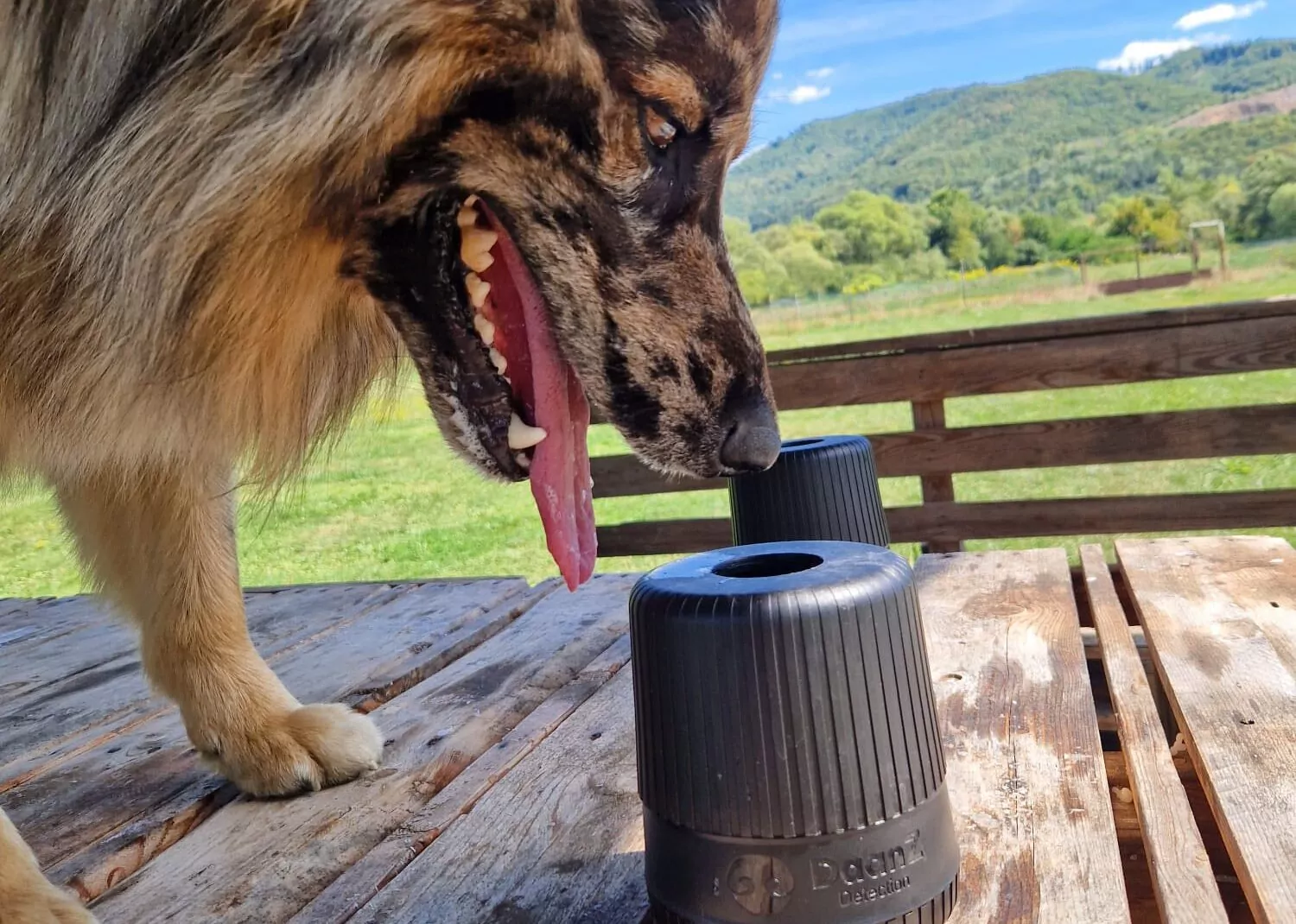
Release your dog and encourage him to explore the boxes. Almost every dog will discover the treat within seconds. Thanks to the round shape of the DaanZ box he can take it out effortlessly. That is his reward. No commands, no corrections, nothing but success.
The aim of this phase is not to make your dog do something difficult. The aim is to build a strong positive association with the detection boxes themselves. Your dog needs to learn that these boxes are great, that wonderful things are inside and that they are worth investigating.
Repeat this three to five times per session, and change which box holds the treat every time. After a few sessions you'll notice your dog walking up to the boxes with more and more enthusiasm and searching more actively. That is the moment to move on to the next phase.
Phase 2: a closed box with odour and food
In the second phase you add a target odour. The treat stays in the box, but now you also add a scent carrier. This can be a cotton ball with a drop of essential oil, or proper training odour. The odour and the food sit together in the closed box.
At first your dog will probably notice little difference. He still follows the smell of the food. But meanwhile something important is happening in his brain: he starts linking the target odour to the reward. Every time he finds the food, he also smells the target odour. In his memory the two become connected.
This is the principle of classical conditioning. On its own, the odour means nothing to your dog at first. But because it always appears together with the food, the odour takes on the same positive meaning. Your dog starts to associate it with something good.
Stay in this phase until your dog goes to the right box quickly and without hesitation. That may take three sessions, or ten. Every dog learns at his own pace. What matters most is that the association is strong enough before you take the next step.
Phase 3: a closed box with odour only
In the third phase you take the food out of the box. Only the target odour is left, without any food. The reward now comes entirely from the handler. This is where the basic association is complete: your dog searches for the odour, indicates the box and waits for his reward from you.
In the earlier phases your dog learned that the odour always comes with something tasty. Now that the odour is still there but the food isn't, a well-conditioned dog will still go to the right box. The odour alone has become enough motivation.
In this phase you also start building duration. At first you rewarded as soon as your dog reached the box. Now you wait one second longer. Then two seconds. Then three. You build up slowly, so your dog learns to keep his nose at the box and wait for the reward. This is the beginning of a reliable indication.
Once your dog reliably indicates a closed box without food and holds his position, you have laid the foundation for real detection work. From here you can raise the difficulty in all sorts of ways.
Raising the difficulty with inserts
The DaanZ Detection boxes come with a unique system of interchangeable inserts. These inserts fit on top of the closed box and change the way the odour leaves the box. Some inserts restrict the flow of odour, so your dog has to work harder to pinpoint the source. Others change the direction of the odour, which makes the search more complex.
With this system you can train for months with the same set of boxes without the exercise becoming too easy. Your dog keeps getting better at finding odours, and the inserts grow with his level. It's like playing a video game where every level is just a little more challenging than the last.
Without inserts you would at some point have to buy new and more expensive equipment to keep the training challenging. The DaanZ system makes that unnecessary. One set of detection boxes with the matching inserts covers the whole journey from beginner to advanced.
Common mistakes when working with detection boxes
The most common mistake is moving through the phases too quickly. Trainers often want to get to the closed box as soon as possible, but every phase has its own purpose and its own timeline. If you skip phase two or keep it too short, you miss the essential odour association and your dog will get stuck in phase three.
Another common mistake is always putting the odour box in the same place. If the target odour is always in the third box from the left, your dog learns a pattern instead of an odour. Always change the position of the odour box and make sure the set-up looks different every time.
The quality of your scent material matters too. Always use fresh scent material and replace it regularly. An odour that has grown too weak gives your dog an unfairly hard task. And don't touch the scent material with bare hands, or you'll spread the odour to places where it doesn't belong.
Always work with clean boxes. If all the boxes smell of the target odour because you don't clean them regularly, your dog can no longer tell them apart. Rinse your boxes with water after every session, with a splash of acetone if needed, and let them dry thoroughly.
Moving on to free searching
Detection boxes are the beginning, not the end goal. At some point you'll want your dog to find odours outside the boxes too. In a room, in a car, outdoors. The boxes have taught your dog what to search for and how to indicate. He takes those skills into every search situation.
Make the move to free searching gradually. Start by hiding the odour in containers other than the familiar detection boxes. Use bags, small boxes, tubes. Anything new, as long as the familiar odour is inside. Your dog already understands the concept; now he learns that the odour can be anywhere.
Next you can hide the odour without a container. On a wall, under a chair, behind a curtain. Your dog is no longer searching for an object but for an odour in the space. This is real scent work, and it is fascinating to watch your dog grow from a beginner taking treats out of open boxes into a focused nose that pinpoints invisible odours. Want to train at height as well? Read more about magnet boxes.
Get started with your own scent detection boxes
The great thing about detection training with boxes is that you can start today. You don't need experience, a special location or an expensive course. With a set of DaanZ detection boxes, a target odour, some tasty rewards and this article as your guide, you can get going straight away.
Start with phase one. Open boxes, visible food, an enthusiastic dog. Enjoy the moment your dog first understands what it's all about. And enjoy even more the moment, a few weeks later, when your dog indicates a closed box with nothing but an odour inside and looks up at you proudly. That's when you realise you are building something special together.
Detection training isn't a trick. It's teamwork. And it all starts with a simple box.
Share this article