Getting started with scent work: the complete guide for you and your dog
Share this article
Picture this: your dog moves through the room with total focus, nose low to the ground, and suddenly stops at an unremarkable little box. He sits, looks at you and waits for his reward. What you just saw wasn't a trick. It was scent work, and one of the most rewarding and challenging things you can do together with your dog.
Scent work, also called detection training or nosework, has become hugely popular with dog owners in recent years. And rightly so. It taps into your dog's natural talents, strengthens your bond and gives him a healthy mental challenge. In this article we take you step by step into the world of detection training: what it is, why it is so valuable and how you can start today.
What exactly is detection training?
In detection training you teach your dog to find a specific odour and to tell you where it is. It is the same principle professional detection dogs use with the police, customs or search and rescue teams, just in an accessible form that suits every dog and every owner.
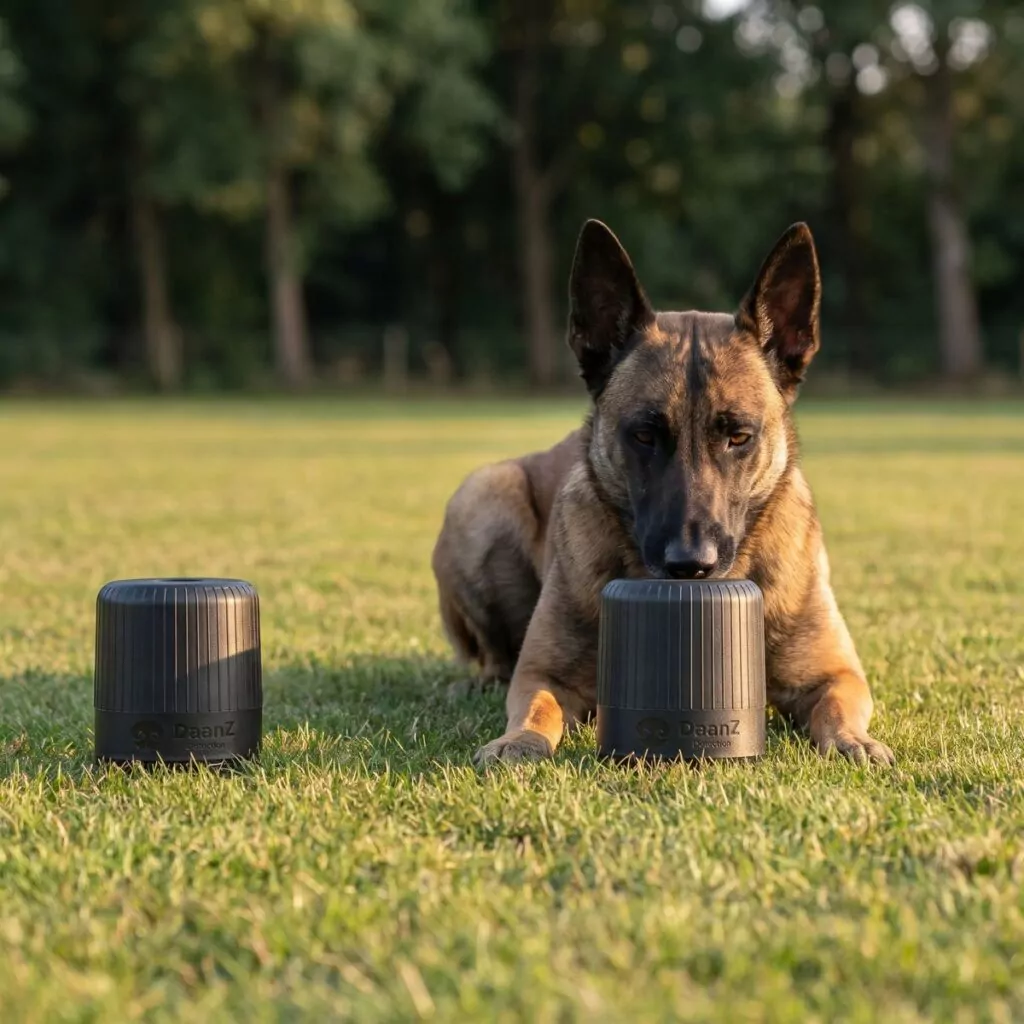
The core is simple: you hide an odour in one of several detection boxes, and your dog learns to search systematically, pick out the right box and let you know. That indication can take different forms. Some dogs sit, others lie down, and others hold their nose at the source. Which one you choose depends on your dog and on your own preference.
The beauty of detection training is that it works for almost any dog. Young or old, big or small, calm or full of energy. Every dog has a nose, and every dog loves to use it. Where many dog sports demand a certain level of obedience or fitness, scent work is mainly a mental challenge. That makes it ideal for dogs who for whatever reason can't run or jump flat out, but also for active dogs who need an extra outlet.
Why detection training is so good for your dog
A dog's nose is an incredible organ. Where we humans have around five million scent receptors, the average dog has about two hundred million, and some breeds have far more. Smelling is to a dog what seeing is to us: it is their main way of making sense of the world.
Yet in daily life we rarely give dogs the chance to really use their nose. We walk the same routes, train on sight and sound, and expect our dog to fit into our human world. Detection training turns that around. You give your dog room to do what he is naturally good at. The result is a dog who visibly blossoms, is calmer at home and gains confidence.
Many owners also notice that problem behaviour decreases once their dog does scent work regularly. Dogs who chew furniture out of boredom, bark too much or wander restlessly through the house often settle down when they get a meaningful job. Detection training fills exactly that need.
Mental tiredness matters at least as much as physical tiredness. Fifteen minutes of focused searching can tire your dog as much as an hour's walk. That makes detection training practical too: you don't need a big field or a lot of time. A living room, a garden or a small patch of woodland is enough for an effective session.
On top of that, detection training does wonders for the bond between you and your dog. You work together as a team. You learn to read your dog's body language and your dog learns to trust you. That mutual understanding carries over into other situations. Dogs who do scent work are often more responsive, calmer in unexpected situations and more focused in other training.
What do you need to get started?
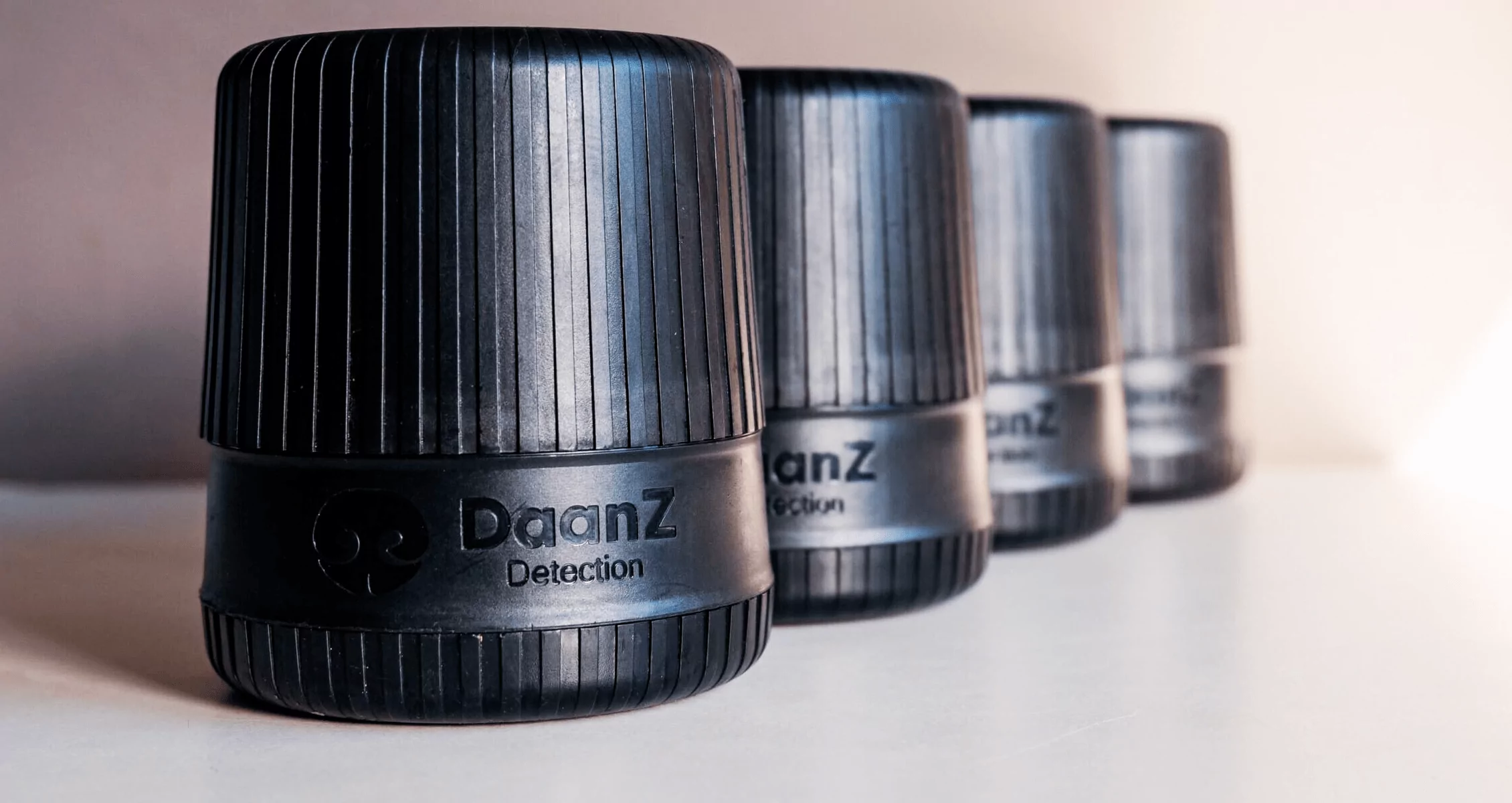
You only need a few things to start detection training. The most important are detection boxes. These are containers in which you can hide an odour while the other boxes stay empty or hold a distracting smell. Your dog learns to find the right box among the others.
You also need a target odour. For beginners it is easiest to start with a smell your dog already loves, such as a piece of cheese or sausage. Our advice is to move on to proper scent material as soon as you can. Switching to neutral odours makes the training more challenging and more realistic.
Finally, you need rewards. These can be treats, but also a favourite toy or a short game of tug. The reward has to be something your dog gets really excited about, because that excitement is what drives the searching.
A quiet training space matters too, especially at the start. Pick a spot with few distractions where your dog can concentrate. Keep other pets out of the room for a while and switch off the television or radio. As your dog improves, you can raise the difficulty by training in new places, adding more boxes or making the odour harder to reach.
Your first training session, step by step
The first session is crucial. The goal is not a perfect search straight away, but a positive association with searching. Your dog needs to learn that searching is fun and that finding pays off with a jackpot.
Start with two or three detection boxes. Put them on the floor with some space between them. While your dog isn't watching, put the odour in one of the boxes. Then release your dog and encourage him to investigate. Most dogs will start sniffing the boxes out of curiosity within moments.
The moment your dog is at the right box and shows interest in it, reward him straight away. Timing is everything here. The faster you reward after the right behaviour, the stronger the association becomes. You can use a marker word such as "yes" or "good", or a clicker (our preference). Say the marker word or click at the exact moment your dog indicates the right box, then give the reward immediately.
A common mistake is training for too long, so your dog gets tired or frustrated. Five to ten minutes per session is more than enough at the start.
The next steps: building up the difficulty
Once your dog understands the basic idea and reliably indicates the right box, you can start building up. Do this gradually and in small steps. First add more boxes, so your dog has to choose between more options. At DaanZ Detection we recommend training with four to six good detection boxes.
Next you can increase the distance between the boxes and spread them around the room. Instead of a neat row on the floor, put boxes on chairs, behind furniture or in another room. Every variation is a new puzzle for your dog.
An important step is teaching an indication. At the start you probably rewarded any sniffing at the right box, but for reliable scent work you want your dog to give a clear signal. The most common ones are sitting at the source, lying down at the source, or pointing at the source with the nose and freezing. Choose one that suits your dog and train it separately before you combine it with searching.
Once the indication is solid, you can start fading out the visible reward. At first you may have had food in the box itself, but in the end you want the reward to come from you after your dog has found and indicated the odour. That shifts the focus from "finding food" to "finding the odour and telling the handler", which is the essence of real detection work.
Common beginner mistakes
The most common mistake is impatience. Detection training is a marathon, not a sprint. It takes weeks to months before your dog searches reliably and independently. Don't rush, and always take a step back when you notice your dog getting stuck or making mistakes.
Another common mistake is helping your dog without realising it. Owners often look at the right box, walk towards it or change their breathing when the dog gets near. Try to stay as neutral as you can while your dog searches.
Punishing mistakes is another big pitfall. If your dog indicates the wrong box, simply ignore it. No "no", no sigh, no disappointment. Wait until your dog searches on and finds the right box. Scent work should be a safe activity where your dog can experiment without fear of getting it wrong. That is the only way to build a dog who goes to work with confidence and enthusiasm.
Always start easy in a new place, though. A new location is exciting enough on its own, so keep the search simple and let your dog succeed.
Scent work as a sport and a hobby
What starts as a fun pastime grows into a serious hobby or even a sport for many people. More and more workshops, courses and competitions around scent work with dogs are being organised. From informal sniffing groups to official trials where dogs are judged on time and precision.
The great thing about scent work as a sport is that it is fair. It's not about how your dog looks, how fast he runs or how perfectly he heels. It is purely about the teamwork between dog and handler and the dog's ability to find odours. That makes it a sport in which truly every breed and age can excel. Whether you have a small terrier, an elderly Labrador or a hyperactive Border Collie, they can all shine at scent work.
Whether you want to train competitively or just need a fun activity for rainy days at home, scent work has something for every level. You can make it as simple or as challenging as you like. From a few boxes in the living room to complex search scenarios with several odours in unfamiliar terrain.
Get started
The most important advice is simple: just start. You don't need to be an experienced trainer and your dog doesn't need to be a special breed. Grab a few detection boxes, a tasty reward and fifteen minutes of your time. Show your dog that searching is the best game in the world. The rest will follow.
Make a habit of doing a short session two or three times a week. Short, regular training works far better than an occasional long session. You'll notice your dog understands what you want faster and faster, and gets more and more excited when you bring out the detection boxes. Some dogs start wagging as soon as they see the boxes, because they know their favourite game is about to begin.
The first time your dog finds a hidden odour on his own and looks up at you with that proud look in his eyes, you'll understand why so many people get hooked on this sport. It is the moment you realise your dog is capable of so much more than you thought. And that together, you are capable of so much more than you ever expected.
Good luck, and above all have fun with your first search session.
Share this article